Built an app with AI? Run it on your hosting
Next.js, FastAPI or anything that listens on a port. No server to administer – restarts, logs and environment variables are in the panel, and after a crash the app comes back by itself.
What you get
A supervised process
Give a directory, a start command and a port. We run the app under your account, and if it dies it comes back by itself.
Your website and SSL
Attach a website to the app with one choice. Traffic goes through the same edge as your other websites, with an SSL certificate.
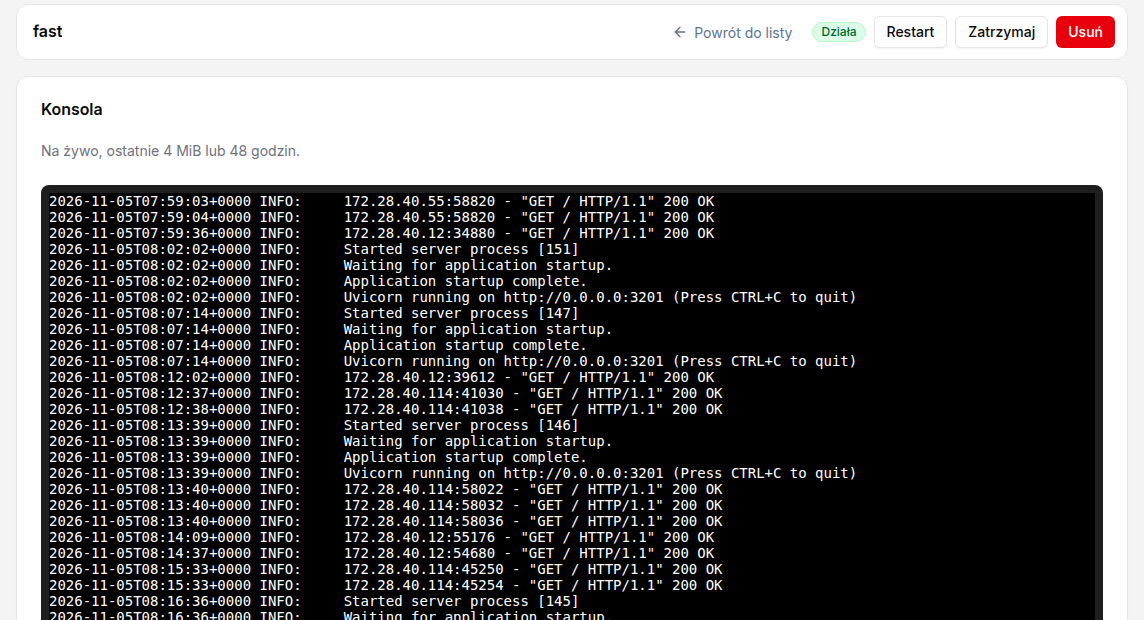
Live logs
Follow the app's output in the panel – the last 4 MiB or 48 hours. Restart, stop and environment variables are right beside it.
The tools you know
Choose from mise, uv, npm, pnpm, yarn, fnm, bun and deno. You pick the version and install it in your home directory. We do not impose one way.
Redis and Memcached
Switch them on in the panel and set the memory. We take care of the configuration and restarts.
Moves without a rebuild
The app lives in your home directory, so it keeps running after your service moves to another server. You do not build it again.
What it takes
We tested this on a setup smaller than our hosting plans: 1 GB of RAM and 1 vCPU. Next.js built in 29 seconds, and once running, three apps and Redis used about 100 MB of memory.
Disk takes more: Node, Python, a Next.js project and the package cache come to about 1.1 GB together. Allow for it when choosing a plan.
Memory is shared between PHP, apps and services. The panel shows the split before you switch a service on.
When a VPS is the better choice
On hosting you run Node and Python apps with Redis and Memcached. There is no Docker or system services of your own here – for those, choose a VPS.
See VPS servers